|
|
|
|||
|
terug naar Home page back to Home page |
||||
|
|
||||
|
|
||||
|
|
Een
overzicht van alle schilderijen uit het Bois d'Amis |
|
Click here for an overview of all the
paintings from the Bois d'Amis.
|
|
|
|
Een boek over de schilderijen uit de schuur.... In
februari 2020 is een boek verschenen onder de titel “Schilderijen uit de schuur: een wandeling door het Bois d’ Amis”. Het boek
(128 pagina’s, volledig in kleur) is te bestellen bij paul@vangeert.nl en
kost 25 € (excl. eventuele verzendkosten). Klik hier
voor het kaft, hier
voor een voorbeeld van de pagina’s 16 tot 21, en hier
voor de pagina’s 42 tot 47 |
A
book on the paintings from the barn (in Dutch). Click
here
for the cover, here
for pages 16 to 21, and here
for pages 42 to 47. Mail paul@vangeert.nl
to order a copy |
||
|
|
Chronologisch overzicht van de werken Een overzicht van de werken uit het
Bois d’Amis volgens jaartal, van 1998 tot 2019... |
|
A chronological
overview Click
here |
|
|
|
Twee nieuwe brochures... Een Engelstalige brochure
met een overzicht van nieuw en representatief werk... De brochure bij de tentoonstelling Le Bois d’Enfants |
|
Two new brochures….
Click
here for an English
brochure about new and representative paintings.... |
|
|
|
Open Atelier April 2015. Klik hier voor een impressie. |
|
Open workshop
April 2015. Click here for an impression.... |
|
|
|
Expositie Beilen
"Le Bois d'Enfants" Stefanuskerk, Prins Bernardstraat 12 Beilen Van 17
augustus tot 15 september vindt er een tentoonstelling plaats met werk rond
het thema kinderen, en mensen en hun kinderen in de brede zin des woords...
De opening is zaterdag 17 augustus 16 uur, door Harry Tupan, adjunct
directeur van het Drents Museum te Assen. Klik hier voor meer informatie over de tentoongestelde werken.. Klik hier voor een impressie
van de schilderijen en hier voor een impressie van de opening.... |
|
The Exhibition The
palette of Paul van Geert-Paintings between 66 and 13 takes place at
the Vestingmuseum Oudeschans.
Click here for more information. Here for an impression, and here for a flash presentation of the older paintings........
|
|
|
|
Vestingmuseum Oudeschans Het
palet van Paul van Geert - Schilderijen tussen 66 en 13 Van 31 maart
tot 1 september 2013 vindt er een expositie plaats in het Vestingmuseum Oudeschans,
met een overzicht van werken van 1966 tot heden. Klik hier voor meer informatie. Klik hier voor een
impressie... Klik hier voor een door Leen
gemaakte presentatie over de oudere schilderijen, waarvan de meeste in Oudeschans
tentoongesteld waren ... |
|
The exhibition Le
Bois d'Enfants takes place at the beautiful
gothic church of Beilen, a small town in the North
of the Netherlands. The theme of the exhibition is the relationship between
people and their children. Click here
for the paintings with description; here for an impression of
the exhibition
|
|
|
|
Uit het hart - Een portret van Paul van Geert In 2007 maakte RTV Drenthe een gefilmd portret van Paul van Geert. Het portret gaan in op de schilderijen, maar ook op het wetenschappelijk onderzoek en de familie.... Klik hier voor de video-clip
|
|
|
|
|
|
Eerdere
tentoonstellingen Van 22
mei tot 14 juli 2007 vond de tentoonstelling Le Bois d'Amis plaats, ter
gelegenheid van het 100-jarig bestaan van het Wilhelmina Ziekenhuis te Assen.
Klik hier voor een foto-impressie van de tentoonstelling..Voor de aankondiging en lezingen tijdens de
opening, klik hier |
|
The Bois d' Amis
exhibition at the occasion of the centennial celebration of the Wilhelmina
Hospital Assen took place from the 22nd of May to
14 July. A photographic impression of the exhibition is available here ... For the opening
texts, click here.
|
|
|
|
De
schilderijen staan opgesteld in de schuur te Westervelde. Klik hier voor een impressie. |
|
The paintings are
exhibited in the barn of the house in Westervelde.
Click here for an impression. |
|
|
|
klik hier voor een impressie
van een geheel ander soort tentoonstelling (Grolloo, 2003) |
|
Here an impression of a very different
kind of exhibition (Grolloo, 2003) |
|
|
|
in 2001
was er een tentoonstelling in het Academisch Ziekenhuis te Groningen, klik hier voor een impressie |
|
Click here for an impression of the exhibition at
the Academic Hospital of the University of Groningen in 2001 |
|
|
|
Klik hier voor een impressie van de tentoonstelling ter gelegenheid
van het ISSBD congres the Gent in 2004 |
|
and here for an impression of the
exhibition at the occasion of the ISSBD congress in Ghent, Belgium, 2004 |
|
|
|
Het ontstaan van een nieuw schilderij Klik hier voor een korte impressie rond het ontstaan van een nieuw schilderij.... Lutgard Waegeman en haar zoon Hans van Fleteren |
|
The making of a new painting ....
Lutgard Waegeman and her
son Hans van Fleteren |
|
|
|
|
|
|
|
|
|
|
|
|
|
|
A short biographical note |
||||
|
Paul van
Geert (1950) began to paint at the age of sixteen. By so doing he followed in
his father’s footsteps, for whom painting was more
than just a pastime. In his native country
His early work is still highly inspired by a
poetic expressions, influenced by painters such as Chagall or the
Flemish Expressionists. Until about the age of twenty-one, he also
experimented with a variety of techniques and art forms, such as sculpture,
ceramics and stained glass, which he practiced in an art workshop for
handicapped people. Although he strongly considered a professional arts
training, he chose for the
Paul van Geert’s interest in the human figure found its first expression in highly simplified representations of people from his immediate environment. Around 1975 he became absorbed by the techniques of early painting and made a theoretical study of the artisanal aspects of painting from medieval times on, which culminated in a rapid shift in the form and technique of his own painting.
Van Geert’s work as a psychologist is closely related to his painting. He is fascinated by the human figure and in particular in the relationship between the changes that take place during development one hand and what remains invariant and characteristic of the person at issue on the other hand. Children are one of his most favorite subjects, and most of his older works consist of small paintings of his own children and family pictured in a variety of daily activities. His recent work contains portraits of mentally handicapped people, his sister, for instance, including a several meters high canvas of a young man throwing sand. However, the relation between the psychologist and the painter is somewhat paradoxical. While the psychologist and researcher tries to capture the most general and abstracted aspects of behavior, the painter does not wish to let any theory or abstraction interfere.
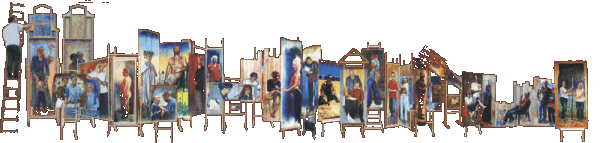
The most recent work – since 1995 – which is shown in this exhibition, represents yet another shift in the approach of the painted subject. The paintings now form a coherent structure, a single work of art, in fact. The painting project “The Wood of Friends” consists of 35 free-standing monumental works, painted on old doors, shutters, old planks and various materials. The paintings represent people from head to foot, and are life-size or bigger. The paintings form a spatial structure that the viewers can explore and walk across. The main idea is that a person’s friends, family or acquaintances create a surrounding space of a special quality, like a wood that surrounds the walker.
|
||||
|
Le Bois d'Amis |
||||
|
De groep schilderijen heeft als titel “Le Bois d’Amis”
(Het Vriendenbos) en bestaat uit zesentwintig vrijstaande schilderijen. De
dragers bestaan uit deuren, luiken en kastdeuren afkomstig uit de sloop, uit
ongeschaafde vurenhouten en lariks planken of eiken planken afkomstig van een
oude aardappelkelder. Het is de bedoeling dat de schilderijen een soort bos
vormen, waar de kijker langs, tussen of rond kan lopen. De opstelling is
afhankelijk van de beschikbare ruimte. De schilderijen kunnen worden
opgesteld in een groepje met de ruggen tegen elkaar, in een losse rij, etc.
Afhankelijk van de ruimte en de opstelling liggen er objecten bij die
toebehoren aan de afgebeelde personen of worden de schilderijen met elkaar
verbonden door balkjes, planken of stokken. Het is ook mogelijk dat er per
werk een korte beschrijving komt van de afgebeelde persoon, met alleen maar
objectieve biografische informatie (geboortedatum en plaats, bezigheden,
etc.). Aangezien de opstelling afhankelijk is van de beschikbare ruimte en de
omgeving valt op dit ogenblik nog geen definitieve beschrijving te geven. De werken hebben geen andere titels dan de namen van de
afgebeelde personen. In het concept Le Bois d’Amis zijn verschillende
ideeën verwerkt. De kerngedachte is dat vrienden en huisgenoten een soort
ruimtelijke omgeving creëren waar je je als persoon in kunt bewegen, een
ruimte die je omringt zoals een bos een omringende ruimte is. Die gedachte
wordt overgebracht door de vrijstaande opstelling (elk schilderij op een
eigen, vaste ezel) en door de afmetingen (ongeveer levensgroot of groter). De schilderijen vormen samen een soort fotoboek. Alle
schilderijen zijn gemaakt naar toevallig gemaakte foto’s, vaak naar
fragmenten van foto’s waar de afgebeelde personen onbedoeld op staan. De
serie schilderijen vormt een fotoboek op ongewone dragers, die afkomstig zijn
uit oude huizen (deuren, luiken, ...) of die direct uit pas gevelde bomen
zijn gezaagd (de vurenhouten planken). De dragers zijn zo gekozen dat ze bijdragen
aan het idee van een omringende en beschermende ruimte (een oud huis, een bos). |
||||
|
|
|
|||
|
|
||||
|
|
||||
|
|
||||
|
|
||||
|
|
||||